Key Takeaways
- Mindfulness / meditation trains attention and reduces reactivity to anxious thoughts, but it is not a stand-alone treatment for clinical anxiety.
- The practice works by changing your relationship to anxious thoughts, not by eliminating them.
- Five to ten minutes of daily practice is a realistic starting point; consistency matters more than session length.
- Mindfulness pairs well with therapy approaches like CBT, but it does not replace professional evaluation when anxiety disrupts daily life.
- If anxious thoughts turn toward self-harm, meditation is not the right tool. Call or text 988 instead.
You sit down, close your eyes, and tell yourself to relax. Thirty seconds later your mind is replaying tomorrow’s meeting, or your chest tightens, or you’re wondering if you’re even doing this right. If that’s been your experience with mindfulness / meditation, you’re not failing at it. You’re discovering what the practice actually is, and it’s different from what most apps and articles promise.
This matters because anxiety convinces people there’s a right way to feel and a wrong way, and that they’re doing both their anxiety and their coping “wrong.” That belief adds a second layer of suffering on top of the first. Understanding what mindfulness can realistically do, and what it can’t, removes some of that pressure.
What mindfulness / meditation actually is
Mindfulness is the practice of paying attention to the present moment, without judging what you notice. Meditation is a structured way of training that attention, usually by focusing on the breath, a sound, or bodily sensations and gently returning your focus each time it wanders.
The wandering is not a mistake. Noticing that your mind wandered and bringing it back is the entire exercise. Many people quit in the first week because they think constant drifting means they’re bad at it, when drifting and returning is the mechanism that builds the skill.
For anxiety specifically, the goal is not to think fewer anxious thoughts. The goal is to change how you relate to the thoughts that show up. A thought like “something bad is going to happen” stays a thought instead of triggering a full physical alarm response.
How it works on an anxious brain
Anxiety often runs on anticipation. Your mind projects forward into a feared future and your body responds as if that future is happening now, with a racing heart, shallow breathing, and muscle tension. Mindfulness interrupts this by repeatedly redirecting attention to what is actually happening right now, which is usually far less threatening than the mental forecast.
Over repeated practice, this builds a kind of mental distance. Instead of “I am anxious,” the experience becomes “I notice anxiety is here.” That shift sounds small on paper, but it changes whether a thought gets to drive your behavior or just gets to pass through.
Breath-focused techniques also work on the body directly. Slow, controlled breathing activates the parasympathetic nervous system, which is the body’s built-in brake on the fight-or-flight response. This is an operational fact about physiology, not a guarantee of relief for every person or every anxious episode.
What a realistic practice looks like
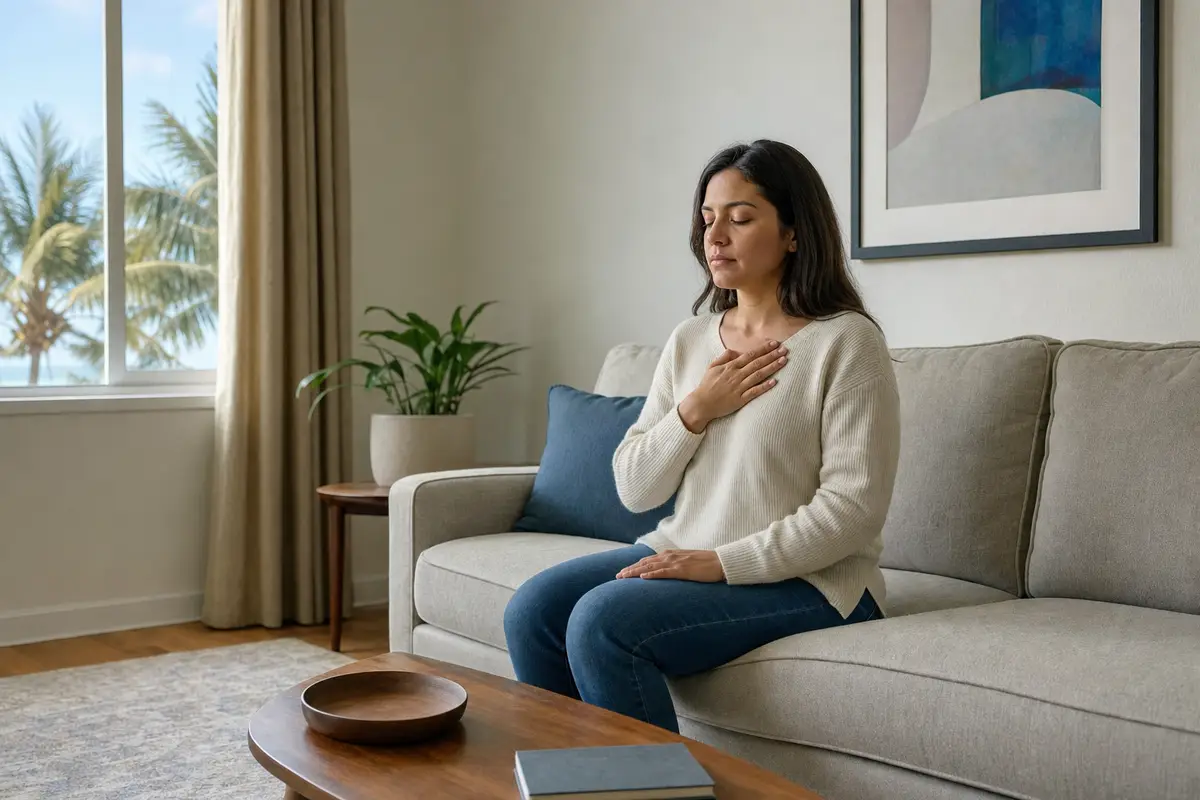
Consider someone who sets a timer for five minutes each morning, sits in a chair, and focuses on the feeling of their feet on the floor and their breath moving in and out. Their mind wanders to a work deadline within the first thirty seconds. They notice this, don’t scold themselves, and return attention to their breath. They do this ten more times before the timer goes off.
That session, by most people’s internal standard, feels like a failure. By the actual standard of the practice, it’s a complete and successful session. The repeated noticing and returning is the training, not a distraction from it.
What mindfulness / meditation can’t do
Mindfulness is not a treatment for panic disorder, generalized anxiety disorder, or other diagnosable anxiety conditions on its own. It’s a skill that reduces reactivity and builds tolerance for uncomfortable feelings, which is useful, but it does not address the underlying patterns of thinking that keep anxiety running in the background of someone’s life.
If you’ve been practicing consistently for weeks and your anxiety still interferes with sleep, work, or relationships, that’s information, not a sign you’re meditating incorrectly. It’s a sign the anxiety needs a different or additional kind of support. Therapy approaches for anxiety are built specifically to identify and change the thought patterns that meditation alone doesn’t touch.
Mindfulness also isn’t the right tool in moments of acute crisis. If anxious or distressing thoughts turn toward thoughts of self-harm, sitting with those thoughts nonjudgmentally is not the appropriate response. If you or someone you know is in immediate danger, call or text 988 (Suicide & Crisis Lifeline).
Mindfulness alongside therapy, not instead of it
A therapist can combine cognitive behavioral techniques with mindfulness practices, using the attention-training skill to create space, and using structured therapy to actually examine and shift the anxious thought patterns underneath. The two work on different parts of the problem.
If you’re trying to figure out whether what you’re experiencing rises to the level of needing professional support, reviewing common anxiety symptoms is a useful starting point. A licensed clinician can also tell you clearly where a meditation habit is enough and where it isn’t during an initial conversation, something worth exploring if you’re asking do I need therapy for anxiety.
A note for older adults
Anxiety doesn’t stop being relevant with age, and a daily mindfulness practice is often more accessible to older adults than high-intensity interventions, since it requires no equipment and can be done seated. That said, anxiety in elderly adults sometimes overlaps with medical conditions or medication side effects, which meditation cannot sort out. A clinical evaluation can.
How to start, realistically
Pick one time of day and five minutes. Morning, before the day’s demands pile up, works well for many people, but there’s no universally correct time.
Use a simple anchor: breath, feet on the floor, or sounds in the room. When your attention wanders, and it will, bring it back without commentary. That’s the whole practice.
Track consistency, not duration. Five minutes daily for a month builds more skill than one forty-minute session followed by two weeks off. If you’re unsure how a new coping skill fits alongside other anxiety support, a conversation about what to talk about in therapy for anxiety shows you where mindfulness fits into a broader plan.
Questions people ask
How long before mindfulness / meditation helps with anxiety?
Most people notice a small shift in reactivity within two to four weeks of daily practice. Meaningful change in how anxiety affects daily functioning usually takes longer and often depends on pairing the practice with other support. This mirrors how therapy for anxiety tends to unfold gradually rather than overnight.
Can meditation replace medication or therapy for anxiety?
No. Meditation is a complementary skill, not a replacement for clinical treatment. A licensed clinician evaluates your specific symptoms and history to recommend a plan; that evaluation is not something an app or a solo practice can replicate. If medication is part of the conversation, only certain licensed providers can prescribe anxiety medication, and that determination requires a clinical assessment.
Is it normal for my mind to wander the whole time?
Yes. Wandering and returning is the exercise itself, not a sign of doing it wrong.
Does insurance cover anxiety treatment if mindfulness isn’t enough?
Many plans do, including Medicare in many cases. Coverage details vary by plan, and it’s worth checking whether insurance covers therapy for anxiety or, for Medicare specifically, whether Medicare covers counseling for anxiety before assuming cost is a barrier.
Where to go from here
If you’ve started a mindfulness practice and it’s taking the edge off, that’s worth continuing. If it isn’t enough, or if you’re not sure how often you’d even need to see someone, how often you should see a therapist for anxiety and whether a therapist can formally diagnose anxiety are reasonable next questions to explore in the anxiety resource section.
Better You Therapy is a Florida-licensed mental health practice providing teletherapy statewide and on-site clinical services in Southeast Florida senior-living communities. A first conversation with a licensed clinician costs nothing in terms of commitment and can tell you plainly whether mindfulness alone fits your situation or whether structured therapy belongs alongside it.